


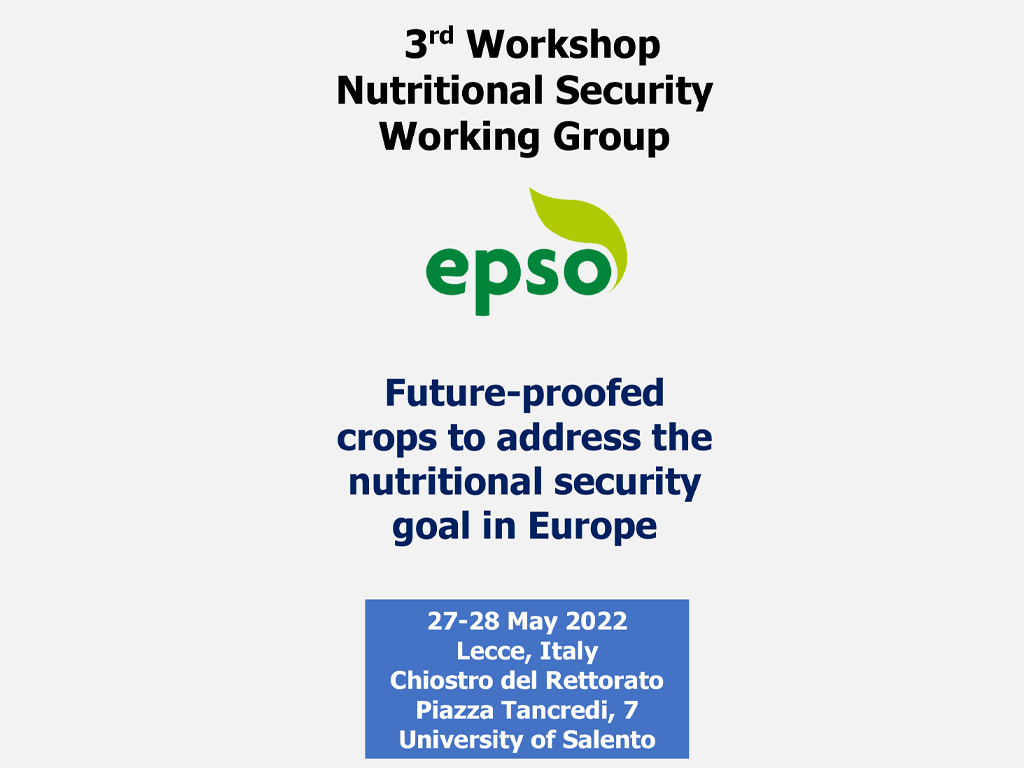
The European Plant Science Organization (EPSO) organizes the workshop entitled “Future-proofed crops to address the nutritional security goal in Europe” on 27-28 May 2022, in Lecce (Italy).
Plant-based foods have received remarkable attention during recent decades in nutrition research, due to the biological activities recognized for many classes of phytochemicals and the relevance that food nutritional security topics are finding in European countries. The availability and accessibility to nutritionally-rich food sources are hallmarks for human health and wellbeing. That is why many efforts are being directed towards both traditional and new crops. The meeting intends to increase collaborations between the working group members both bi-and multi-lateral. In addition, it will provide information to finalise the EPSO statement on Nutritional Security, including recommendations on R&I as science advice to policy to the European Commission as well as national authorities.
The EPSO ‘Nutritional Security’ WG aims to discuss and contribute to defining new paths and solutions for resilient and sustainable production systems using innovative solutions in the food and nutrition area
The workshop will be carried out as a hybrid event.
To participate online, please register at:
https://attendee.gotowebinar.com/register/7690122185825291280
Workshop sessions:
- Session 1: Improving the nutritional value of major and minor (neglected) crops
- Session 2: Recovery and stabilization of primary/secondary metabolites from food matrices & side-products
- Session 3: Environmentally friendly and valuable alternatives to traditional food sources
- Session 4: Assessing the nutritional value and safety along food chains
Contacts:
Angelo Santino angelo.santino@ispa.cnr.it
Marina Korn korn@igzev.de
Agenda of the meeting is attached to this news.


